
Vietnam shapes a new AI vision: “Fast - Safe - Humane”
At the VinFuture 2025 Talk, Deputy Minister of Science and Technology Bui The Duy emphasized: Artificial Intelligence (AI) must become a national intelligence infrastructure and be developed based on ethics, transparency, and social responsibility.
On the afternoon of 2 December, 2025, within the framework of the VinFuture Science and Technology Week 2025, the Talk “AI for humanity: ethics and AI safety in the new era” took place in Hanoi with the participation of international scientists, technology experts, and representatives of the VinFuture organization.
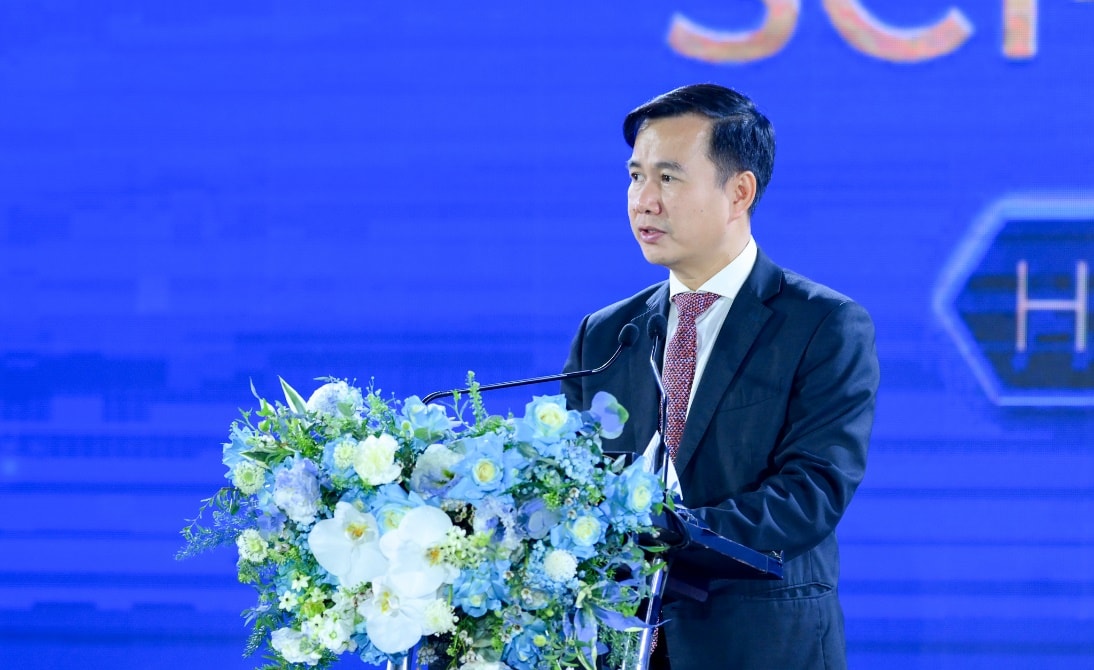
Developing Artificial Intelligence in a fast, safe, and humane direction
Speaking at the opening of the Talk, Deputy Minister of Science and Technology (MST) Bui The Duy emphasized Vietnam's strategic vision for developing AI in a fast, safe, and humane manner.
Vietnam issued its first AI Strategy in 2021, but the rapidly changing technological landscape requires an update. By the end of this year, Vietnam will announce a new AI Strategy along with the Law on AI - the first legal framework to position AI as "national intelligence infrastructure".
This is not just a technical program, but a declaration of the country's development path, in which AI serves social welfare, promotes sustainable growth, and enhances national competitiveness.
According to Deputy Minister Bui The Duy, AI is shifting from a tool to an essential infrastructure system similar to electricity, telecommunications, or the Internet. Any nation that masters the AI infrastructure, including data, algorithms, models, and computing capacity, will hold a superior advantage in the economy, society, and national defense and security.
Vietnam is building a national AI supercomputing center, promoting an open data ecosystem, and developing a Make in Vietnam AI platform based on an open philosophy: Open standards, open data, and open source code.
“Openness is the path to receiving global knowledge, mastering technology, and contributing back to humanity. It is also the key to ensuring safety and transparency in AI applications,” Deputy Minister Bui The Duy stressed.
Another highlight in the speech was the importance of the domestic market. Without applications, there is no market, and without a market, AI businesses cannot thrive. Vietnam will boost the application of AI in state agencies, while the National Technology Innovation Fund will dedicate up to 30-40% of its resources to support small and medium-sized enterprises, including AI vouchers, to create a sufficiently large market demand for Make in Vietnam products.
The Deputy Minister added that Vietnam aims for AI transformation, not just AI application. This is a process of restructuring the nation's management, production, and creative activities based on the AI platform, similar to the turning points of industrialization and digital transformation in the past. With a young population of 100 million, rapidly increasing technological capabilities, strategic technology clusters, and a dynamic startup ecosystem, Vietnam possesses the crucial conditions to move fast in the AI era.
Alongside the opportunities, AI also poses significant challenges regarding ethics, employment, and social trust. Vietnam is therefore committed to developing AI according to the "Fast - Safe - Humane" model: AI is a powerful support tool, but humans must always be the final decision-maker. Soon, Vietnam will issue a Code of AI Ethics, and continue to refine the AI Strategy and Law on AI based on principles of risk-based management, transparency, accountability, and the protection of national digital sovereignty.
According to the Deputy Minister, in the digital era, technology is global, but data is local. Important applications must operate on Vietnamese AI infrastructure, ensuring a balance between international and national platforms. This is precisely the opportunity for developing countries, where the advantage lies not only in core technology but also in the cultural context, data, and internal problems of each nation.
Deputy Minister Bui The Duy believes that AI is a historic opportunity for Vietnam to break through and become a high-income developed country: “Nations that transformed into 'Dragons' or 'Tigers' all made good use of industrial revolutions. After decades of construction and development, Vietnam has become the world's 32nd largest economy and has all the necessary conditions to enter the AI era, boosting labor productivity, achieving double-digit growth, consolidating governance capacity, and national defense.”
The Vietnamese AI declaration emphasized by Deputy Minister Bui The Duy consists of 7 values: Humane - Open - Safe - Autonomous - Cooperative - Inclusive - Sustainable. This will be the guiding principle for all of Vietnam's AI policies in the coming time.
Trustworthy AI needs to converge: safety, accountability, privacy, transparency, humanity, community, responsibility
In the discussion session, Assoc. Prof. Luu Anh Tuan (National University of Singapore) emphasized that Vietnam is facing a special opportunity to develop AI, as it possesses a young population, rapidly growing technological capabilities, and a determination to invest in domestic large language models such as VinaLLaMA or PhoGPT.
However, for AI to truly serve socio-economic development, the key factor is "trustworthy AI," meaning the system must be accurate, transparent, culturally appropriate for Vietnam, and have clear accountability mechanisms. Risks such as misinformation, data bias, or the leakage of sensitive information can erode public trust if not strictly controlled.
Assoc. Prof. Luu Anh Tuan also pointed out Vietnam's specific challenges, from the regional diversity in language and accents to the lack of high-quality Vietnamese datasets and the lack of national standards for model development.
Vietnam needs to build clean, comprehensive datasets that truly reflect cultural values, implement an ethical licensing mechanism, create a whitelist-blacklist of information, and promote open-source models for the community and businesses to jointly participate in monitoring, Assoc. Prof. Luu Anh Tuan proposed.
AI must move in a safe, humane, and responsible direction, becoming the foundation for Vietnam to shift from an "AI user" to an "AI creator," thereby consolidating digital sovereignty and creating a competitive advantage in the AI era./.
Translated by Vietnam Journal of Science and Technology (VJST - MOST).