Vietnam and Belgium strengthen cooperation in scientific research
From April 1 - 4, 2026, in Hanoi, the National Foundation for Science and Technology Development (NAFOSTED) collaborated with the Flanders Research Foundation, Belgium (FWO) to convene joint scientific council sessions to evaluate proposals for the NAFOSTED-FWO Bilateral Research Cooperation Program submitted in 2025.
With a rigorous selection process aligned with international standards and a total budget of approximately 2.3 million EUR, the program continues to affirm its role as a vital bridge in promoting basic research and scientific cooperation between the two parties.
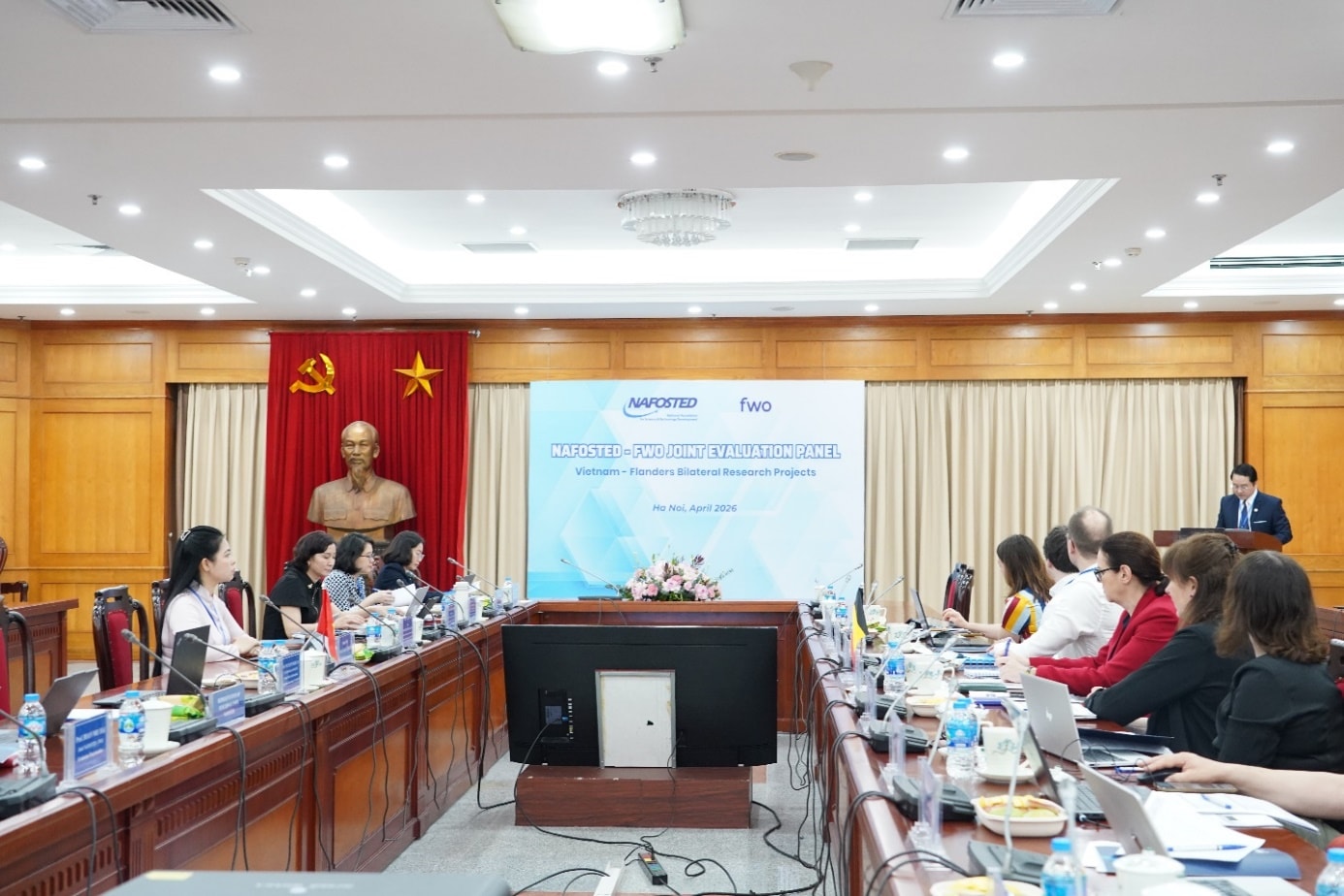
In his opening remarks, Assoc. Prof. Dr. Dao Ngoc Chien, Director of NAFOSTED, stated that since establishing cooperation in 2009, NAFOSTED and FWO have built a reliable and effective partnership.
Over the past 15 years, the two organizations have jointly launched seven calls for proposals, funding 43 research projects across various fields. These results have not only strengthened connections between research groups but also enhanced the scientific quality of international cooperation programs.
Notably, the 2025 call marks the eighth round of collaboration, recording a sharp increase in interest from the scientific community, with the number of registered proposals nearly tripling compared to the previous call. This clearly reflects the growing demand for international cooperation and demonstrates the continuously improving research capacity of scientific teams.
On this basis, the Director of NAFOSTED expressed expectations that both sides would continue to expand and further deepen their cooperation, aiming for high-quality research outcomes with significant impact.
Echoing this perspective, Dr. Isabelle Verbaeys, Head of International Relations at FWO, observed that the achieved results demonstrate not only the scale of cooperation but also core values such as trust, respect, and a mutual commitment to scientific quality. According to her, the program's success is built on a foundation of open exchange, transparency, and mutual learning, thereby creating a sustainable cooperation mechanism oriented toward long-term goals.
The FWO representative also emphasized that, in the coming period, both parties will continue to develop high-quality research programs focused on addressing increasingly complex global challenges. In this context, the evaluation process is considered a key stage, serving not only a technical function but also a guiding role for the sustainable development of the joint research ecosystem. She also acknowledged the proactive coordination from the Vietnamese side - a crucial factor in ensuring the substantive effectiveness of collaborative programs.
During the working sessions, the scientific council conducted evaluations of proposals using the SWOT analysis method, clarifying the strengths, limitations, opportunities, and challenges of each project. Based on this, members discussed and reached a consensus on scoring, ranking, and proposing budget allocations for the highest-quality topics.
The entire evaluation process was conducted under strict principles of ethics and confidentiality. Experts participating in the council operated independently and recused themselves from evaluations in cases of conflict of interest to ensure objectivity and transparency.
According to the plan, the final results will be finalized and announced around May–June 2026. Selected projects are expected to commence implementation on July 1, 2026, contributing to the promotion of high-quality basic research, strengthening international academic linkages, and enhancing Vietnam's scientific standing on the global stage./.
Copyright belongs to the Vietnam Journal of Science and Technology (VJST-MOST)