
Shaping a tripartite investment cooperation model for Vietnam’s innovative startups
On the morning of 13 December, 2025, within the framework of the national innovative startup festival TECHFEST Vietnam 2025, the Forum "National Policy and International Cooperation on Investment for Innovative Startups" took place. The Forum focused on discussing institutions, capital flows, and investment cooperation models, aiming to build a sustainable and internationally integrated innovation ecosystem.
Completing the venture capital investment institution from local practice
The Forum "National Policy and International Cooperation on Investment for Innovative Startups" was held in the context of the Government issuing Decree No. 264/2025/ND-CP on national and local venture capital funds, establishing for the first time a unified legal framework for venture capital activities in Vietnam. The focus of the Forum was to discuss the effective implementation of this Decree, while clarifying the roles of the State, the private sector, and international financial institutions in sharing risks and mobilizing resources for innovation.
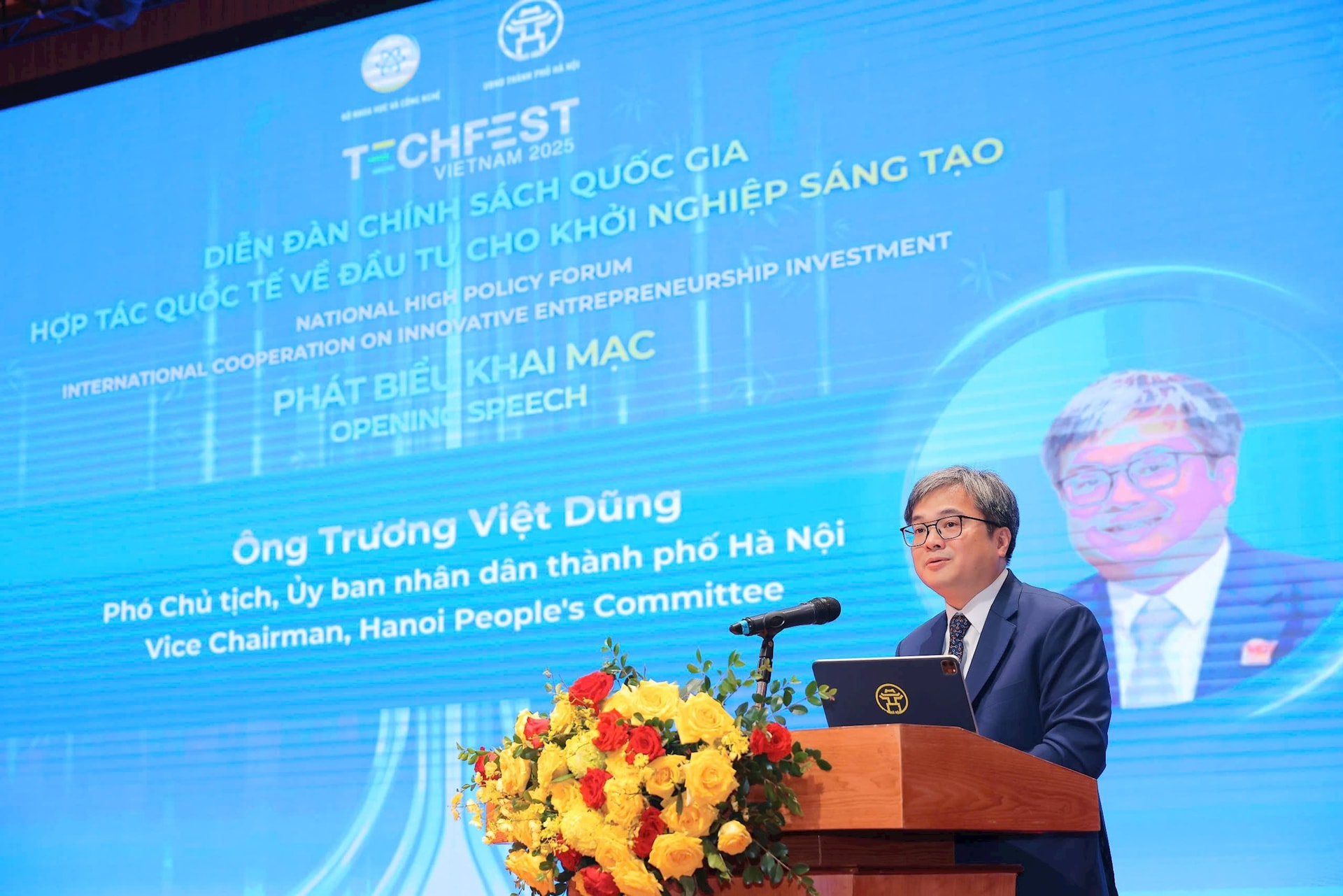
Delivering the opening speech at the Forum, Mr. Truong Viet Dung, Vice Chairman of the Hanoi People's Committee, stated that in the process of perfecting the institutions for innovation in Vietnam, Hanoi has been assigned the pioneering role to lead and pilot new mechanisms. Based on the revised Capital Law, the City has simultaneously issued resolutions encompassing the entire innovation ecosystem, from controlled testing mechanisms for new technologies, science and technology policies based on order placement and expenditure assignment down to the final product, to the establishment of the Hanoi Venture Capital Fund with a maximum size of 1,200 billion VND, in which State budget capital participates up to 49% as seed capital.
According to the Vice Chairman of the Hanoi People's Committee, these mechanisms are unified by the core principle that the State does not replace the market, but plays a constructive role, shares initial risks, prioritizes the public-private co-investment model, and creates space for the private sector to lead innovation. Hanoi determined that piloting venture capital models is not only aimed at attracting capital but, more importantly, at creating a flexible institutional environment where technological ideas can be tested, commercialized, and scaled up.
Global capital flow, co-investment model, and tripartite cooperation
A pervasive content of the Forum was the analysis of global venture capital flow restructuring trends and investment cooperation models suitable for Vietnamese conditions. The presentations at the Forum showed that in the context of global economic volatility, venture capital flows tend to be more selective, focusing on deep-tech fields, energy, infrastructure, and smart supply chains, while setting higher requirements for risk management and investment efficiency.
Discussing at the Forum, Mr. David Lewis, Chairman and CEO of Energy Capital Vietnam, clarified the leading role of the private sector and cross-border investment cooperation models in solving socio-economic problems. According to the Chairman and CEO of Energy Capital Vietnam, connecting corporate capital flows with innovative solutions from startups not only creates new growth momentum but also helps economies enhance their capacity to participate in the global value chain.
From the perspective of a development financial institution, Mr. Samuel Ang, Senior Specialist at the Asian Development Bank (ADB), shared experiences in operating co-investment mechanisms such as matching funds and fund of funds. These models allow for the effective mobilization of private capital, while transparently allocating and managing risks, and are considered important suggestions for the process of building and operating the national venture capital fund in Vietnam.
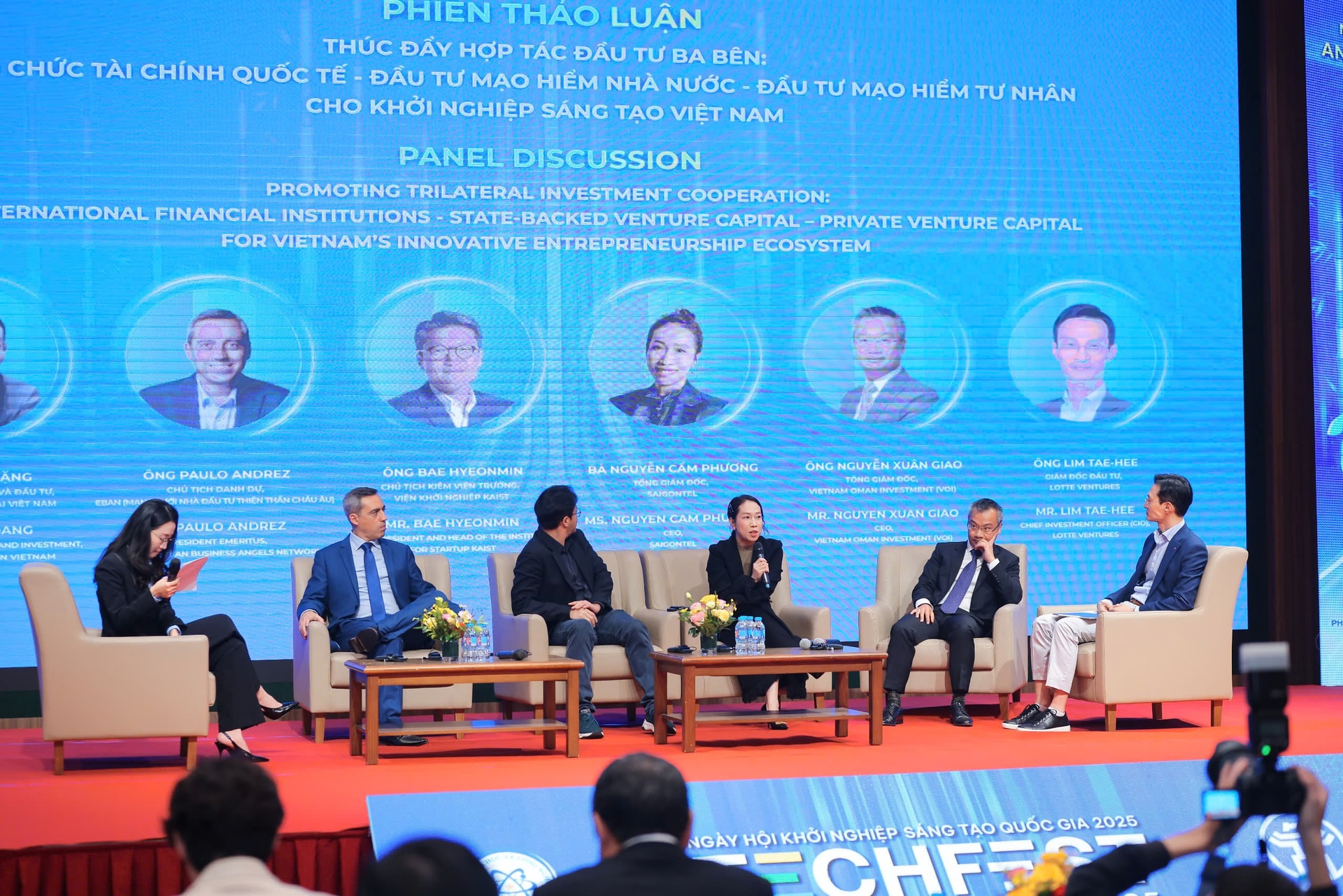
Following the discussing sessions, the Forum continued with a thematic panel discussion "Promoting tripartite investment cooperation: international financial institutions - state venture capital - private venture capital for Vietnamese innovative startups". The panel discussion focused on exchanging views on coordination mechanisms among stakeholders, international experience in risk sharing, and effective co-investment models, thereby clarifying the complementary roles of state capital, private capital, and international resources in developing the innovative startup ecosystem.
Innovation is the inevitable path for Vietnam’s sustainable growth
Concluding the Forum, Deputy Minister of Science and Technology Hoang Minh affirmed that innovation has become the foundation for S&T development in most countries, and Vietnam is no exception to this trend. According to the Deputy Minister, in the context where the world is witnessing a sharp decline in capital flow for startups, from about 600 billion USD in 2021 to about 300 billion USD in 2024, Vietnam is also affected as venture capital decreased from 1.5 billion USD to about 500 million USD during the same period.
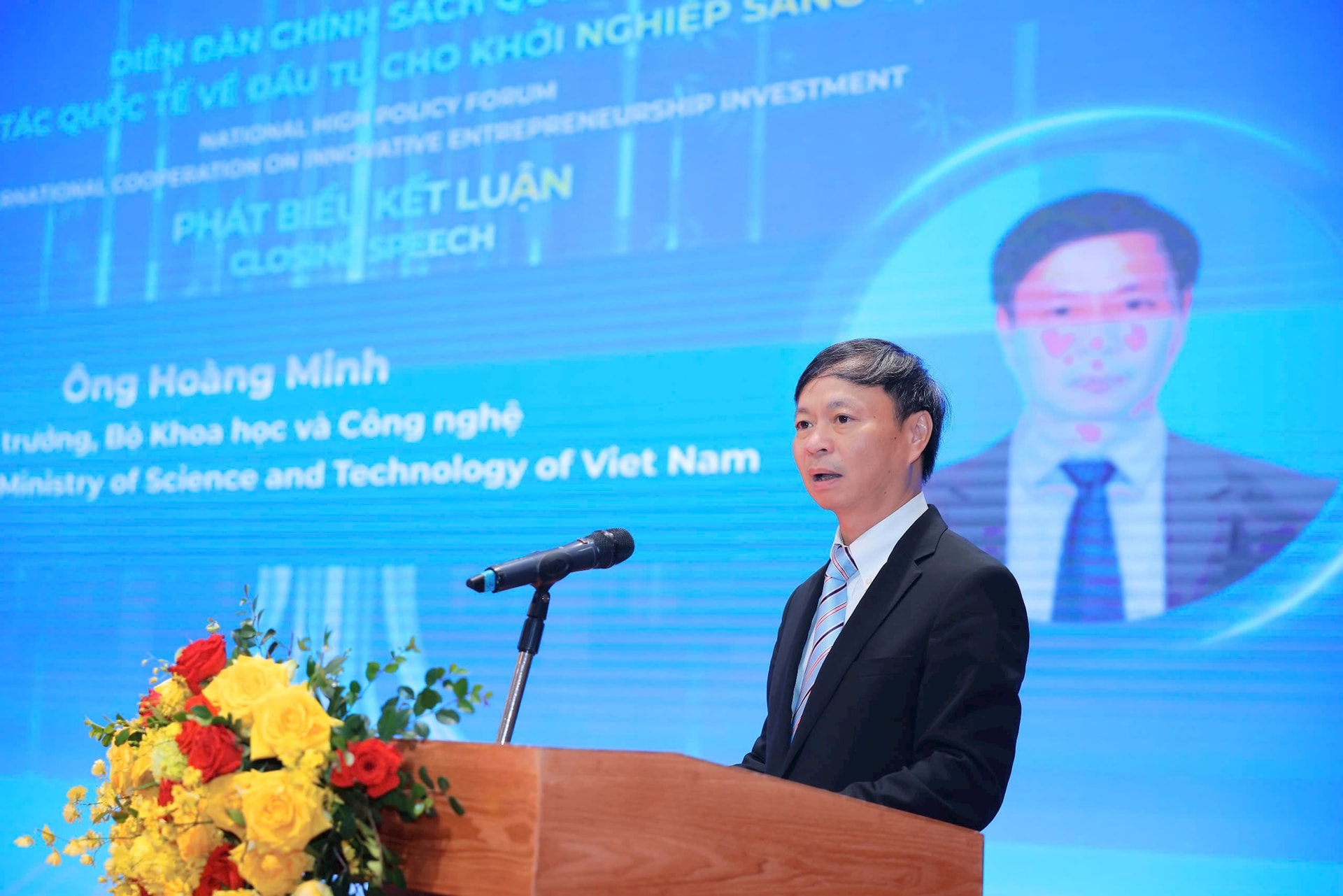
However, Deputy Minister Hoang Minh stated that these difficulties do not overshadow the results that Vietnam's startup ecosystem has achieved. Currently, Vietnam has over 4,000 startups, about 200 intermediary organizations supporting startups, and 2 technology unicorns. Vietnam's Innovation Index ranks 44th out of 132 countries, and the growth rate of the startup ecosystem is among the highest in the ASEAN region. This is an important foundation for Vietnam to continue pursuing the goal of development based on science, technology, and innovation.
According to the Deputy Minister, the first-time establishment of national and local-level venture capital funds sends a clear message from the Government about its direct participation in the startup ecosystem, not just stopping at policy support. Decree 264 allows the venture capital fund to operate on a long-term cycle of 10 to 15 years, invest by portfolio instead of single deals, be allowed to invest in other funds, invest abroad, and focus on strategic technology sectors and green technology.
Deputy Minister Hoang Minh emphasized that the state venture capital fund is not intended to compete with the private sector but plays a complementary, leading, and driving role for the entire ecosystem. The ultimate goal is to attract capital, technology, and talent, creating conditions for Vietnamese enterprises to start up and develop domestically, thereby forming long-term growth momentum based on science, technology, and innovation./.
Copyright belongs to the Vietnam Journal of Science and Technology (VJST-MOST).