
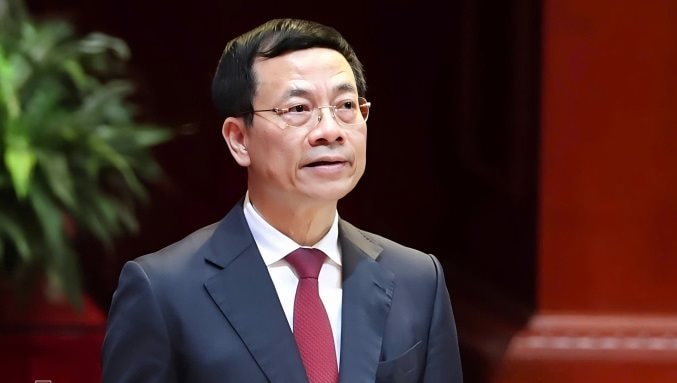
Minister of Science and Technology Nguyen Manh Hung speaks about AI
"We have faith that humanity will live well with Artificial Intelligence (AI) and its issues. And in the future, humans will create many more things beyond AI, all for the purpose of making humans more human."
The Vietnam Journal of Science and Technology respectfully introduces the article by Minister of Science and Technology Nguyen Manh Hung on AI.
Vietnam issued the first AI Strategy in 2021. However, AI is a rapidly changing field. By the end of this year, we will have an updated AI Strategy and a Law on AI. This is not just a legal framework, but a declaration of the national vision: AI must become a national intelligence infrastructure, serving the people, promoting sustainable development, and enhancing national competitiveness.
AI is an intelligence infrastructure. AI is not just an application technology; it is becoming a type of national infrastructure, similar to electricity, telecommunications, or the Internet. Whoever masters AI will gain a superior advantage in production, business, healthcare, education, national governance, and even defense and security. Vietnam must have a Vietnamese AI intelligence infrastructure. Vietnam is rapidly building a national AI supercomputing center and an open AI dataset.
We will carry out AI-ization much like electrification, but we will AI-ize faster, as quickly as possible. We will promote AI popularization, mass AI literacy, similar to the English learning movement in the past, or the illiteracy eradication campaign 80 years ago. Every Vietnamese person will have an AI assistant; while the population doesn't increase, the social intelligence will at least double. Previously, only officials from the ministerial level up had assistants, costing thousands of dollars, but now, an ordinary citizen can also have an assistant, costing only 10 dollars.
Regarding open AI technology. Vietnam is committed to developing and mastering digital technology, including AI, based on open standards and open source. This is not just a commitment but also our strategy: Openness for development and technological mastery, for Make in Vietnam, and also to contribute to humanity. Openness to utilize the knowledge of others and to create a higher baseline for others. And openness is also a way to ensure safety.
Regarding creating a domestic AI market for development. Without applications, there will be no market. Without a market, Vietnamese AI enterprises will forever remain small. Therefore, promoting the application of AI in businesses, state agencies, and key sectors is the fastest way to develop AI, to create Vietnamese AI enterprises. The Government will spend more on AI, and the Technology Innovation Fund of the Ministry of Science and Technology will dedicate at least 30-40% to support AI applications, providing vouchers for small and medium-sized enterprises to use Vietnamese AI. The domestic market is the cradle for creating Vietnamese AI enterprises.
Regarding AI transformation. We do not speak of AI application, but of AI transformation. AI transformation is the process of comprehensively restructuring the operations of an organization, a sector, and the nation based on artificial intelligence, aiming to create new capabilities in management, production, creation, and sustainable development. Speaking of AI transformation is to affirm that this is a strategic, national-scale process, similar to "industrialization" or "digital transformation." Speaking of AI transformation means placing transformation, changing the operating model, at the core.
Regarding Vietnam's opportunity. With a young, dynamic, tech-savvy population of 100 million, Vietnam has the conditions to be both a fast user and a creator of AI products for itself and for the world. Vietnam is a developing country, and the Party and State are setting very high goals, leading to many challenges and major problems, and this is precisely the opportunity for AI.
The Prime Minister has issued a List of Strategic Technologies, in which AI is a key technology that we will prioritize resources for development. We can move faster thanks to: the national AI computing infrastructure, the data ecosystem, Make in Vietnam digital technology enterprises, and a force of research, startups, and a young, tech-loving community. AI startups will be a significant driving force for Vietnamese AI development.
AI also poses challenges and responsibilities. AI opens up huge opportunities but also raises many issues regarding ethics, employment, and social trust. Therefore, we must develop AI to be fast, safe, and humane. AI is for humanity, not replacing humans but serving them. AI is a powerful tool, but humans remain the ultimate decision-makers; let AI support, not replace human thinking, values, and responsibility.
Regarding policies and institutions. We will issue a National AI Ethics Code, harmonizing with international standards but tailored to the Vietnamese reality, and build the Law on AI and AI strategy based on the following core viewpoints:
First, risk-based management.
Second, transparency and accountability.
Third, placing people at the center.
Fourth, encouraging domestic AI development, self-reliance in AI.
Fifth, utilizing AI as a driver for fast and sustainable growth.
Sixth, protecting digital sovereignty. Where data, infrastructure, and AI technology are the three strategic pillars of digital sovereignty.
An important feature of the fourth industrial revolution is the balance between the power of the big players (Big Tech) owning core technology and the advantage of countries/businesses that understand the local context, language, culture, and own specialized data for specialized applications. In the era of digital transformation, the technology is global, but the data is local. Important specialized applications must run on Vietnamese AI infrastructure. There is a global AI infrastructure, but there is also a national AI infrastructure. There are global platforms, but there are also national platforms. There are global applications (like ChatGPT), but there are also countless national applications.
The combination of global and national will help our world develop more sustainably. And this will be an opportunity for developing countries like Vietnam. The advantage of Vietnamese enterprises is Vietnamese data, Vietnamese problems; their advantage is open source AI, and the fundamental advantage is the Vietnamese people, Vietnamese intelligence, and the flexibility and adaptability of Vietnamese culture – which are the most necessary and important qualities in an era where technology is creating rapid and breakthrough changes.
We are also officially defining the path for Vietnamese AI development. If one word must be used to describe this path, it is the word "and." Global and local. Cooperation and self-reliance. Big Tech and startups. Technology and application. Elite and mass-market. Usage and mastery. Creation and control. Global infrastructure and national infrastructure. Open data and protected data. Foundational, general-purpose AI and specialized AI customized for each sector. Large AI and small AI dedicated to each task, each organization. Generative AI and analytical AI. Open technology and closed technology. Integration for learning and contribution and self-reliance to protect national interests.
The fast and sustainable development of AI must be based on the word "and." Human history has mainly used the word "or," which is why there have been many wars; now, it is time for the word "and" to become central. The level of human civilization corresponds to the extent to which we know to place "and" instead of "or."
AI development must be based on four pillars, which are also very important "and": AI institutions, and AI infrastructure (computing, data, algorithms, models), and AI human resources, and AI culture. Transparent AI institutions, modern AI infrastructure, high-quality AI human resources, and humane AI culture.
There is one more "and", which is AI and its issues. The power of AI may be greater than nuclear energy, and therefore, the problems it creates may be larger than the atomic bomb. But AI and its issues are twins, like yin and yang, like two sides of a coin, relying on each other to coexist and develop, and they transform each other. The issues of AI can be solved by AI itself, for example, training AI human resources using AI technology, or detecting AI ethical violations also using AI.
AI grows up alongside the very problems it creates. Without the issues of AI, there would be no maturity of AI. AI and its issues is a great "and". AI and its issues will always exist; we cannot eliminate them, but must coexist and govern them wisely. And how we coexist is our choice.
AI is a tremendous opportunity for Vietnam to rise up and become a high-income developed country, on par with major nations across five continents. All countries that have transformed into "dragons" or "tigers" are those that seized the opportunity of new industrial revolutions. Previously, due to war, we missed those opportunities, but now, the country is at peace, Vietnam has escaped poverty to become an upper-middle-income country, and is already the 32nd largest economy in the world. We have the sufficient conditions to grasp this opportunity, concentrating all resources to AI-ize Vietnam, to double Vietnamese intelligence, increase labor productivity, achieve double-digit economic growth, enhance national competitiveness, improve national governance capacity, and better protect Vietnam, making Vietnam stand shoulder-to-shoulder with major nations and contribute to humanity.
The Declaration on Vietnamese AI is: Humane - Open - Safe - Self-reliant - Cooperative - Inclusive - Sustainable.
And finally, I would like to reiterate a point mentioned above. That is, AI is a powerful tool, but humans remain the ultimate decision-makers; let AI support, not replace human thinking, values, and responsibility. AI is a helpful assistant, a colleague, a tool to enhance capability, but ultimately, it is to support humans so that humans become more human.
70,000 years ago, humans created language, the tool of thought, and learned how to live well with it; it helped humans become much more human. We have faith that humanity will live well with AI and its issues. And in the future, humans will create many more things beyond AI, and we will live well with them, all for the purpose of making humans more human, moving closer to God. We are more human not only because we exploit the favorable aspects of technology but also because we confront the adverse aspects of technology. Perhaps even mostly because of the adverse aspects./.