
Law on AI will help Vietnam achieve breakthrough in global AI race
Vietnam is standing at a historic turning point as the draft Law on Artificial Intelligence (AI) has been submitted by the Ministry of Science and Technology (MST) to the National Assembly, expected to be adopted in the near future, positioning Vietnam among the pioneering nations worldwide with specialized AI legislation. This is a clear testament to the strong commitment of the Party and the State, which regards AI as a leading strategic technology, a new "national intelligence infrastructure" as crucial as electricity or the Internet.
The early promulgation of the AI Law, placing Vietnam in the same group as leading nations and regions like the EU, South Korea, and Japan, demonstrates a clear vision and the aspiration to master, advance towards autonomy, and affirm national digital sovereignty over AI. Mr. Ho Duc Thang, Director of the National Institute of Digital Technology and Digital Transformation, emphasized that the core spirit of the law "is not to tighten management, but to create a safe, open legal corridor."
This is precisely the way to ensure that "institutions precede and pave the way for technology development," creating a safe, risk-management-based legal environment to foster innovation.
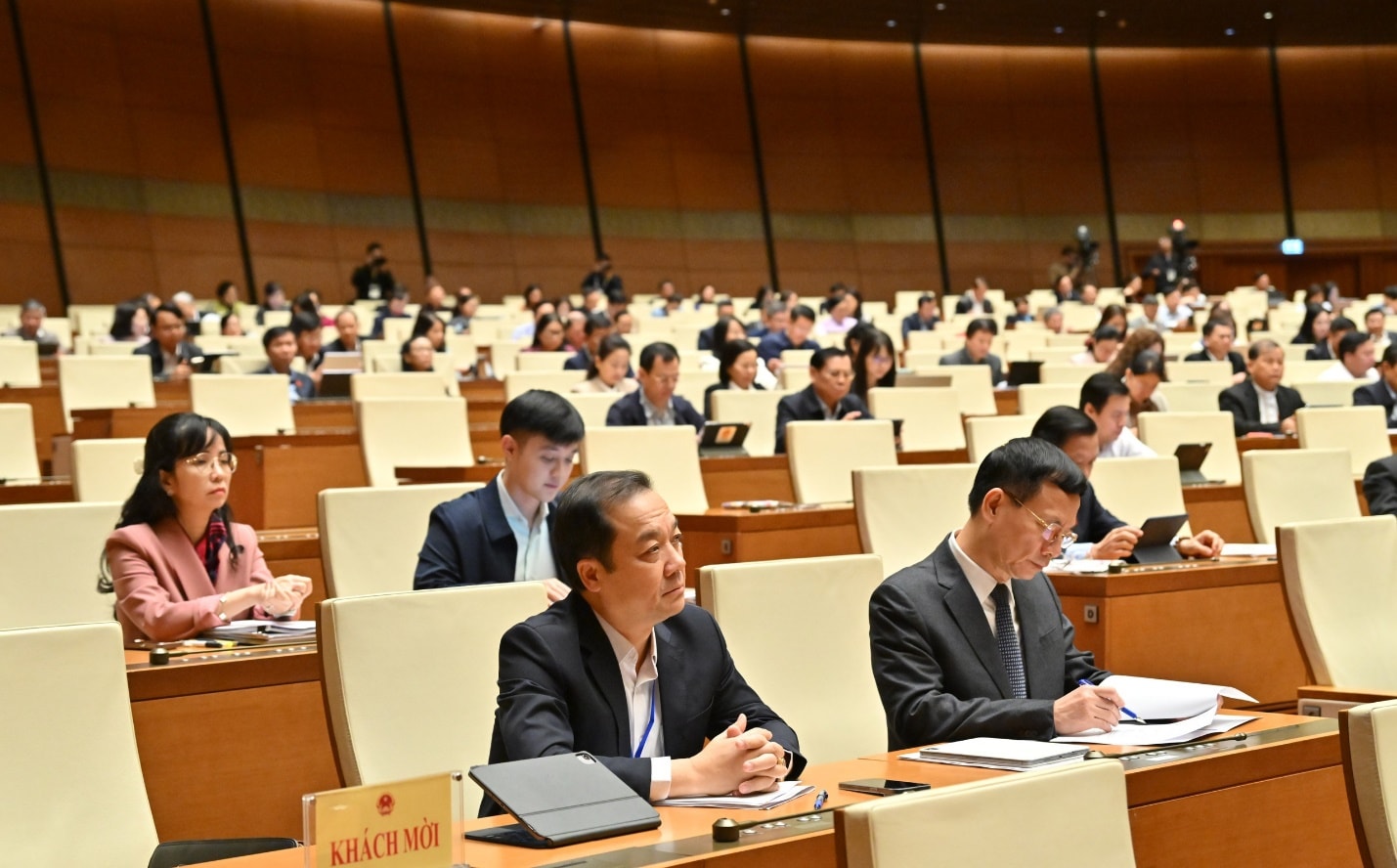
The Law on AI Law with a spirit of creation and development
Contrary to concerns about a restrictive legal corridor, Vietnam's Law on AI is built with a creative spirit, putting people at the center and promoting development.
Deputy Minister of Science and Technology Bui Hoang Phuong affirmed that the draft Law is based on core principles: putting people at the center, ensuring safety and transparency, promoting inclusive and sustainable development, and maintaining balanced and harmonious governance.
One of the most significant highlights of the draft Law is the risk-based approach to AI management. Instead of applying a uniform management mechanism, the law will classify AI systems, with high-risk systems subject to strict supervision. This approach helps balance encouraging innovation with protecting the rights of citizens and businesses, ensuring AI develops rapidly, safely, and humanely.
Transparency is also a key requirement. The Law clearly stipulates that users must be informed when interacting with AI, aiming to address the growing challenge of distinguishing between human-generated and machine-generated content, thereby protecting social trust.
In addition to management, the Law on AI also aims to create strong development momentum. Specific preferential mechanisms and policies for AI research and development (R&D) will be issued. The issue of AI ethics is also given a vital position.
Deputy Minister Bui Hoang Phuong emphasized that no matter how advanced AI becomes, the final decision-making authority must still belong to humans. Minister Nguyen Manh Hung also affirmed: AI must be for people, serve people, but not replace people.
Thus, the Law on AI acts as the "foundational brick," the guiding institution, creating a fair, transparent playing field that encourages businesses and scientists to confidently innovate within a clear and safe legal framework.
The Law on AI is the foundation for the national vision
The Law on AI is not a standalone policy, but a series of strategic steps Vietnam is taking to seize the "historic opportunity" in the new technological revolution.
Minister Nguyen Manh Hung has defined AI as "national intelligence infrastructure" and stated that whoever masters AI will have a superior advantage in all fields. To master this infrastructure, Vietnam is focusing on simultaneously developing key pillars.
AI institution, standards, and safety: This is the role of the Law on AI. Along with the Law on AI, Vietnam is also developing a new AI Strategy, a national action program on AI, and a code of AI ethics. A pioneering institution will shape the game, ensuring AI does not "stifle innovation" or "lead to social risks."
National computing and data infrastructure: This is the physical foundation for AI. Recognizing this, the State will play a leading role in investing in large-scale high-performance computing (HPC) centers. The goal is to achieve autonomy in computing capacity, ensuring non-reliance on any single business or nation.
Specifically, the MST will build a national AI supercomputing center valued at $300 million over the next 3 years, with an initial phase of $100 million in 2026. Large corporations like Viettel are also heavily investing, operating 15 data centers and continuously expanding, investing in world-leading GPU systems. Regarding data, which is likened to the "fuel" of AI, it is tied to national sovereignty and must be mastered.
Human resources and intellectual community: People are the key factor. Vietnam possesses the advantage of a population of over 100 million, a young, dynamic, and tech-savvy workforce. The national strategy is to build a "dual" workforce generation—one that understands semiconductor hardware and masters advanced AI algorithms. This is the foundation for long-term autonomy.
Financial resources and application ecosystem: To boost the market, the MST plans to establish a national AI development fund. Notably, an "AI voucher" mechanism will be implemented to directly support businesses, especially small and medium-sized enterprises, in applying AI, thereby creating a sufficiently large demand. The Government is also reforming public procurement with an "AI first" approach, prioritizing domestic open AI products and commissioning AI to solve national problems.
"Historic opportunity" for the semiconductor industry and digital economy
The development of AI infrastructure and the promulgation of the Law on AI create a dual impact, not only promoting the AI industry itself but also creating a "massive order" for other high-tech industries, especially semiconductors.
Mr. Ho Duc Thang affirmed that this is the biggest opportunity for Vietnamese semiconductor businesses. The development of AI infrastructure, with the need for supercomputing centers and millions of GPUs, will stimulate the entire domestic value chain, from design, packaging, testing, to the production of "Make in Vietnam" chips.
In parallel, the training of a "dual" workforce (AI and semiconductors) will ensure Vietnam has the capability to operate and develop both strategic fields.
From a business perspective, AI is no longer a futuristic story but a tangible growth driver. Mr. Le Hong Viet, CEO of FPT Smart Cloud, pointed out that for every one USD invested in generative AI, businesses can achieve a return on investment (ROI) of 3.7 times. "AI Agents" are being strongly applied to transform the way businesses operate.
The engagement of Vietnamese businesses is robust. FPT Smart Cloud proposes a strategy of "building sovereign AI" based on four pillars: People, digital infrastructure, products, and ecosystem. Viettel is methodically investing in data and GPU infrastructure. CMC established CMC OpenAI with the vision of developing large language models for Vietnamese people.
Affirming Vietnam's position
Although classified as an "emerging potential" group in ASEAN, with a nascent ecosystem and a 2024 investment capital of $80 million, Vietnam is showing incredible development speed. By September 2025, 18% of Vietnamese businesses (about 170,000 companies) had applied AI, an increase of nearly 40% compared to the same period last year. 42% of the population and 65% of SMEs have adopted AI solutions.
Vietnam's goal is very clear: To be among the top 3 leading countries in Southeast Asia in AI research and development by 2030. The reward for this effort is immense. According to forecasts by Boston Consulting Group, AI could contribute up to $130 billion to Vietnam's GDP by 2040.
The Law on AI is the highest-level commitment of the nation. By "creating an open legal corridor" and synchronously developing the pillars of infrastructure, human resources, and finance, Vietnam is demonstrating clear determination and vision. As Minister Nguyen Manh Hung emphasized: We are standing before a great door. With the determination and joint efforts of the State, businesses, the scientific community, and society as a whole, Vietnam can completely turn this opportunity into success./.
Translated by Vietnam Journal of Science and Technology (VJST - MOST).