
Hanoi: Architecting a modern public service governance system via "triple helix" model
As a core academic and policy consultancy pillar, the University of Economics and Business (UEB) under Vietnam National University, Hanoi (VNU), is collaborating with Hanoi to architect a modern public service governance model based on the "triple helix" partnership: State - University - Enterprise.
In the context of Hanoi’s accelerated digital transformation and efforts to enhance governance efficacy, the deployment of a task execution governance and personnel evaluation system utilizing objectives and key results (OKR) and key performance indicators (KPI) marks a significant transition in administrative reform.
Strategic "triple helix" cooperation for a digital public governance system
On January 30, 2026, the Hanoi Department of Science and Technology, UEB-VNU, IBPO Joint Stock Company, and G Group Joint Stock Company signed a Memorandum of Understanding (MoU) for consultancy and implementation of an IT-enabled task management system using OKR/KPI methodologies. This represents a landmark milestone in Hanoi's public administration reform process.
The objective of this partnership extends beyond mere software development; it aims to establish a comprehensive governance system that enables leaders at all levels to monitor, measure, and evaluate task performance quantitatively, transparently, and in real-time.
A defining characteristic of this collaboration is the "triple helix" model: the State acts as the architect and coordinator; the University provides the theoretical framework, methodology, and research; and the Enterprise undertakes the development of technological solutions. This approach ensures scientific rigor and practical feasibility while allowing advanced governance models to be piloted and flexibly adjusted before city-wide scaling.
As Hanoi implements the Politburo’s Resolution No. 57-NQ/TW dated December 22, 2024, regarding breakthroughs in science, technology, innovation, and national digital transformation (Resolution 57), the requirement to innovate governance methods based on data and science has become imperative. This cooperation is thus viewed as a critical pilot step in transitioning from traditional bureaucratic administration to objective- and results-based governance.
Within this collaborative structure, the University of Economics and Business holds the central academic and methodological role. Beyond consultancy, the University directly constructs the objective frameworks, indicator systems, and operational models tailored to the specificities of the public sector.
The core of the system lies in translating strategic goals into specific measurable indicators. OKRs help define objectives and the key results required to achieve them, while KPIs serve as tools to quantify the degree of task completion.
This allows the entirety of the administrative apparatus’s activities to be "visualized" on a digital platform from work progress and completion rates to the specific responsibilities of individuals and units.
Mr. Nguyen Truc Le, Secretary of the University of Economics and Business Party Committee, stated that KPIs are not merely "scoring" tools but a solution to restructure work motivation in the public sector. The fundamental shift is moving from subjective assessment to governance based on real-time data.
According to Mr. Nguyen Truc Le, the OKR/KPI system is designed to measure goal achievement at the organizational, unit, and city-wide levels, thereby directly supporting leadership, administration, and performance evaluation.
This serves as the foundation for a phased transition from process-based management to results-oriented governance, while standardizing and digitizing task systems to form a unified governance database.
From pilot to deployment on the Hanoiwork digital platform
Following the MoU signing, the system was piloted at several units, including the City Party Committee’s Organization Commission, the Department of Science and Technology, and select ward-level local authorities.
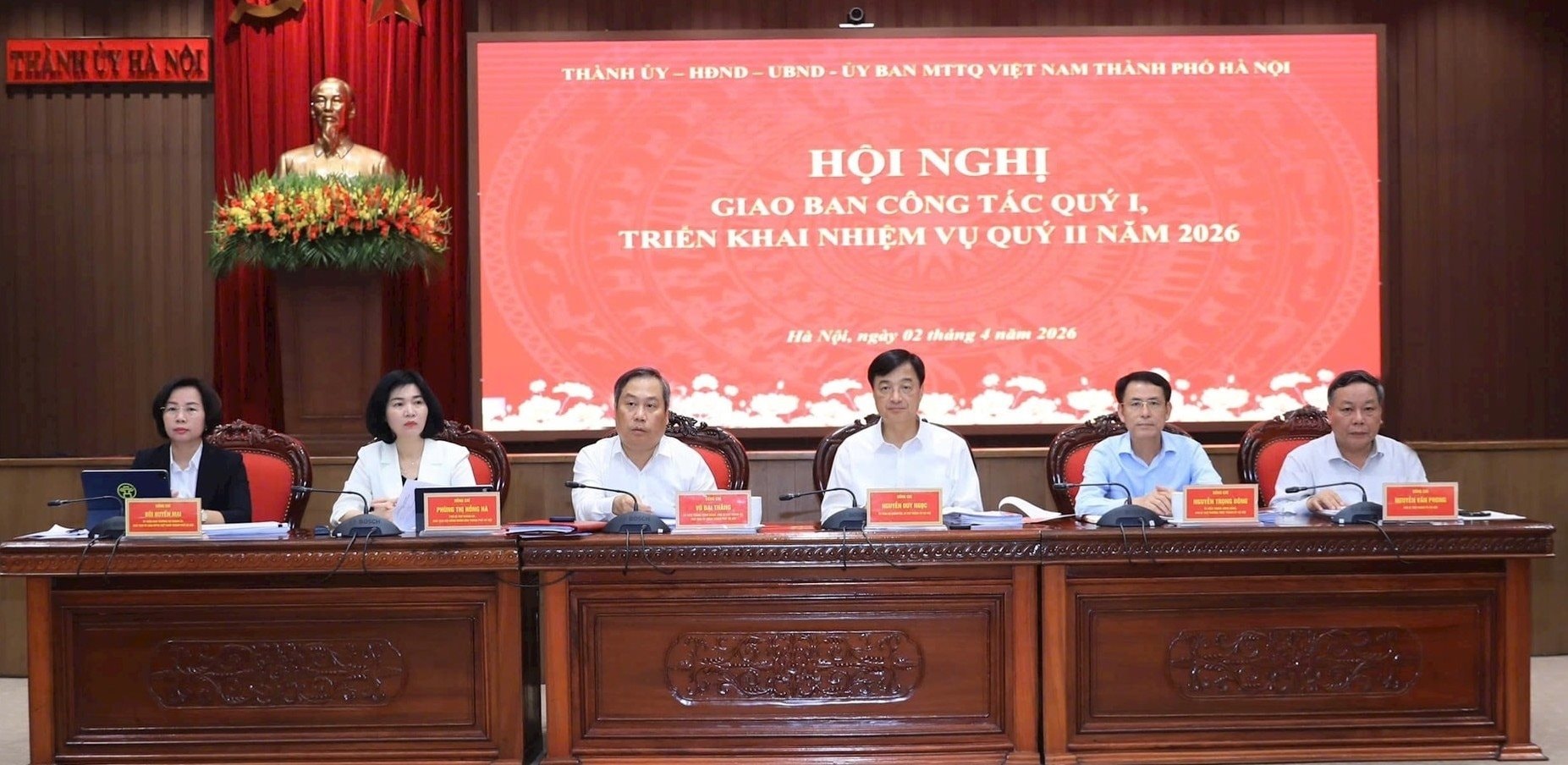
The chosen approach of "learning by doing" allowed for model adjustments based on practical feedback before expansion. By April 2, 2026, at the Q1 Review and Q2 task deployment Conference, Hanoi officially launched and operationalized the "task execution governance and personnel evaluation platform" on the HanoiWork digital workspace.
This platform integrates the entire process of task assignment, progress tracking, and result evaluation into a unified, interconnected system across all levels and sectors.
Every official is assigned clear objectives with specific measurable indicators and deadlines. Progress is updated continuously, enabling leaders to identify bottlenecks and make timely adjustments. Evaluations are no longer based on intuition but on data and specific work outputs.
Notably, the system has been integrated across dozens of departments and hundreds of grassroots-level units, creating a synchronized task governance network city-wide. Digitizing these workflows has significantly reduced meeting times and document circulation, enhancing coordination efficiency between agencies.
Implementing OKR/KPI is seen as a fundamental shift in the governance mindset of the public sector. Previously, personnel evaluation relied heavily on processes and workload; now, the focus has shifted to outputs and value generated. The KPI system has become a "measure of resolution implementation," allowing leaders to track the realization of guidelines and policies quantitatively.
Simultaneously, aligning individual goals with unit and city-wide objectives creates tight integration within the system, ensuring synchronization in leadership and administration.
This also forms the basis for a new work culture rooted in data, transparency, and accountability. The critical point of this model is not to "rank" officials, but to provide a support tool for increased efficiency while offering leaders a scientific basis for decision-making.
Toward a data-driven public governance ecosystem
The deployment of the OKR/KPI system via the "triple helix" model opens a new pathway for administrative reform in Vietnam. Rather than fragmented reforms, this model aims to build a data-driven public governance ecosystem where decisions are informed by complete, accurate, and timely information.
In the long term, the system will serve not only task management but also create a vital database for the planning, training, and development of personnel. Furthermore, it acts as a foundation for connecting with other systems within the digital government to form a synchronized digital ecosystem.
With a methodical approach involving stakeholders and led by reputable research institutions, this model is expected to create substantive changes in public governance, contributing to the enhanced power and efficiency of the administrative apparatus./.
Copyright belongs to the Vietnam Journal of Science and Technology (VJST-MOST)