
Digital Government: The shift and implementation challenge
The core of digital government does not merely aim at digitizing procedures or improving public services, but reaches into the depths of governance structures: data is established as a strategic type of infrastructure for national governance.
Resolution No. 57-NQ/TW (December 22, 2024) of the Politburo identifies science, technology, innovation, and digital transformation (STI & DT) as the foremost strategic breakthrough and the primary driver for developing modern productive forces, promoting sustainable growth, and enabling Vietnam to break through in the new era.
One of the central tasks is building and perfecting the national data system, treating data as the core infrastructure of modern governance. The 2026 goal aims to complete 100% of national and specialized databases, particularly data related to administrative procedures.

Digital government in the context of competition and growth model innovation
In a context of increasingly fierce global technological competition, where national advantage is measured by data capacity, innovation, and implementation, Digital Government is identified as the central pillar of the development strategy. The Politburo’s issuance of Resolution No. 57-NQ/TW demonstrates the highest political determination in regarding STI & DT as the strategic breakthrough of the new era.
In that spirit, the National Assembly and the Government have concretized this orientation through action and institutions. Dozens of bills, decrees, and circulars related to STI & DT were issued in 2025, creating a legal foundation for the actual deployment process.
Simultaneously, the administrative apparatus is being restructured toward a real-time data-driven governance model, where data becomes the core operating infrastructure replacing fragmented, paper-based management methods.
Within this general picture, online public services (OPS) have become the most specific and recognizable expression of Digital Government. The implementation of Project 06, the operation of the national population database with over 104 million verified records, and the integration of dozens of utilities on the VNeID platform have created the prerequisite for a public service model that is independent of administrative boundaries.
In this model, the satisfaction level of citizens and businesses is gradually becoming the substantive measure of governance effectiveness.
Implementing Digital Government: A measure of local capacity
The focus of digital government is not just directed toward digitizing procedures or improving public services, but touches the deep layers of the governance structure: data is established as a strategic infrastructure of national governance.
Therefore, the shifts in rankings over the past 5 years should be viewed as a measure of foundational capacity.
National digital infrastructure is step-by-step approaching international standards: telecommunications infrastructure rose 41 places to rank 67th; Internet speed rose 42 places to rank 18th. Vietnam's e-Government ranking according to the United Nations rose 15 places, standing at 71/193 countries. Information security ranks 17th.
Project 06 is considered a turning point as population data becomes the "digital lifeblood" connecting governance systems. Over 104 million population records have been verified; the VNeID platform integrates over 50 utilities, recording an average of more than 3 million visits per day, while Digital Citizen applications and the National Legal Portal expand access to services and information toward transparency, interaction, and cross-boundary accessibility.
However, the actual implementation of Digital Government reflects a multi-layered picture, as each locality enters digital transformation with different conditions, pressures, and speeds.
As the country’s largest economic center, Ho Chi Minh City identifies administrative reform and digital transformation as the central drivers for maintaining sustainable growth. In a context where the digital economy contributes approximately 20% of GDP with over 45,000 tech firms operating nationwide, the city plays a role in testing and leading modern governance models.
The city is reviewing all guiding documents to make timely adjustments suitable for reality, pushing administrative reforms toward a minimum 50% reduction in time and compliance costs. 100% of eligible procedures will be conducted as full-process online services; at least 80% of records will be processed entirely in a digital environment, regardless of administrative boundaries; the target for on-time resolution is over 98%.
The HCMC People's Committee has issued an administrative reform plan with 92 tasks across 6 areas: institutional reform, administrative procedures, organizational apparatus, public service regimes, public finance, and building e-government and digital government. Tasks are assigned with clear personnel, specific work, set timelines, and implementation responsibility.
Heading toward 2030, HCMC targets a digital transformation index of 0.75 or higher, ranking among the top three leading localities in the country. Digital infrastructure will be developed synchronously with 5G coverage reaching 100% of the population, completing the City Data Center and connecting it with the National Data Center.
If HCMC represents the large-scale urban governance challenge, Ha Tinh has emerged as a bright spot in online public service implementation efficiency. According to statistics from the National Public Service Portal, in 2025, Ha Tinh made a clear mark on the administrative reform map by achieving 21.5/22 points in record digitization, ranking first among 34 ranked provinces and cities.
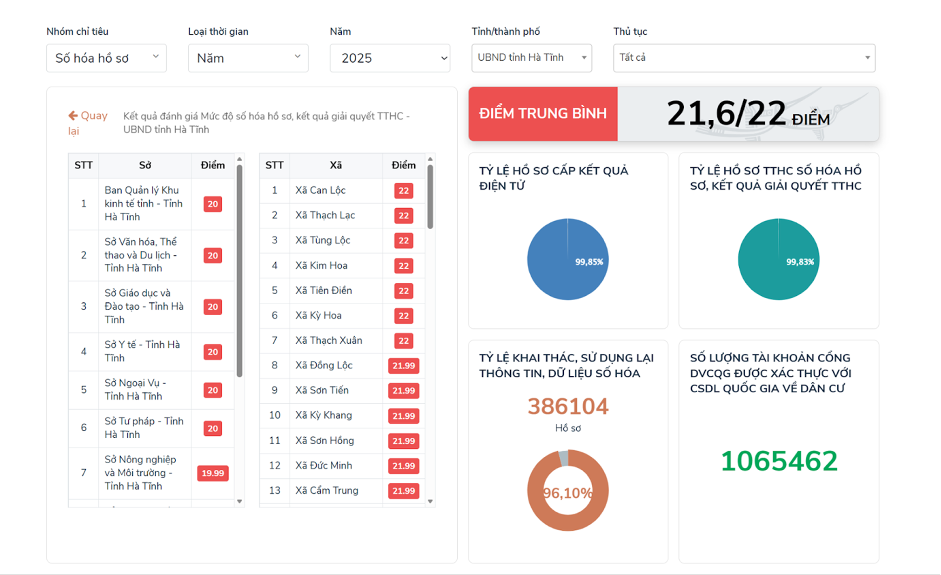
That momentum continued in February 2026 with the online submission rate reaching 99.71%, full-process records at 99.74%, and on-time resolution at 95.37%—among the highest in the country. These results show that exploiting data on businesses and land, along with 100% digitization of records and procedural results, has become substantive.
Moving into 2026, Ha Tinh aims to raise reform standards across 7 core areas, from institutions and organizational apparatus to building digital government associated with ISO 9001:2015. The province requires 100% of agencies to issue and implement reform plans; at least 35% of units to undergo periodic inspections; and strives for at least 3 effectively applied initiatives.
Targets have been markedly raised: resolving records on or ahead of time at over 99%, with satisfaction levels reaching 95% or higher; full-process online records reaching 70%, and online payments at least 75%. Simultaneously, all procedures must be updated on the national database, 100% of records and results issued electronically, progressing toward completing procedures regardless of administrative boundaries in 2026.
Unlike the two localities that have entered the acceleration phase, Dien Bien Province is proactively choosing a cautious but calculated path for the 2026-2030 cycle: building institutional and governance foundations in parallel with digital transformation.
On the increasingly perfected national digital infrastructure—mobile bandwidth covers 99.44% of villages and hamlets; 5G reaches over 91% of the population; over 50 utilities integrated on VNeID with an average of 3 million daily visits nationwide—the conditions for mountainous residents to access public services have expanded significantly.
Digital infrastructure here not only helps bridge geographical distances but also creates a foundation for process restructuring, shifting from manual record processing to data-driven governance, reducing dependence on traditional administrative spaces.
The Dien Bien Provincial People's Committee identifies perfecting legal documents according to decentralization and improving implementation quality as the key axis, while shifting strongly from a "management" mindset to a "development-enabling" one.
The commitment to cut at least 50% of resolution time and 50% of administrative procedure compliance costs compared to 2024 is placed within the logic of data-driven reform: not requiring the re-submission of digitized documents, and not creating unfeasible procedures or business regulations. Parallel to this is enhanced decentralization and delegation coupled with tightened administrative discipline and the responsibility of heads of agencies, using substantive results as the measure.
The three localities represent three different states of the Digital Government process: a mega-city with high operational pressure; a medium-sized province breaking through in implementation rates; and a mountainous locality laying the foundation for an acceleration phase.
The effectiveness of Digital Government implementation is seen not only through individual local stories but also through national indicators on OPS provision. As of January 21, 2026, the rate of full-process online records out of total administrative procedure records resolved during the month reached 51.09%. Among these, the ministerial block reached 66.87%, while the provincial block reached 22.87%. Compared to the same period in January 2025, this rate nationwide has increased by 16.79%.

Five years of transition: Restructuring governance on a data platform
Digital transformation in Vietnam does not occur through disjointed steps but is designed according to a roadmap characterized by inheritance and acceleration through each stage. From the milestone of officially establishing the National Digital Transformation Program in 2020 to the operation of two-level local governments by 2025, every step has been linked to a major shift: from the electronification of procedures to building core data infrastructure; from providing OPS to restructuring the operational methods of the apparatus.
.png)
Milestones in the national digital transformation process
The past five years of transition have, in essence, only been the tip of a deeper restructuring process, where the State is shifting from a procedure-based management model to a data-driven operating model.
In the context of increasingly fierce global competition and where national advantage is measured by both technological capacity and the ability to organize implementation, the Digital Government cannot stop at administrative reform or process digitization. This is not just a reform goal, but a condition for Vietnam to position itself in the world's new development order./.
Copyright belongs to the Vietnam Journal of Science and Technology (VJST-MOST)