
Application of artificial intelligence in the activities of cadres and civil servants in the current period
In the context of accelerating national digital transformation, artificial intelligence (AI) has become one of the key technologies, playing a particularly important role in the process of innovating state management activities and improving the quality of service for the people. For the contingent of cadres and civil servants - the force directly implementing administrative management tasks and providing public services - the application of AI is not only an inevitable requirement but also a vital solution for building a modern, professional, transparent, and effective administration.
AI is opening new opportunities for innovating the working methods of administrative agencies. With the ability to process big data, automate processes, and support decision-making, AI helps reduce processing time, minimize errors, and enhance the quality of service for citizens and businesses. Applications such as virtual assistants, data analysis systems, automatic document classification software, and chatbots for administrative procedure support are becoming increasingly common and demonstrating clear efficiency.
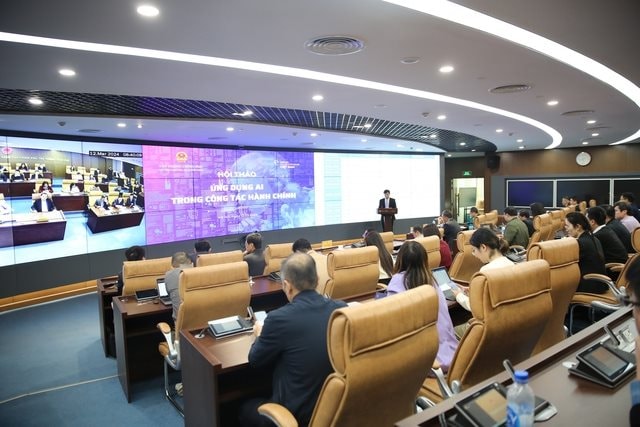
In resolving administrative procedures, AI helps simplify processes, transparentize information, and reduce dependence on manual operations. This not only contributes to improving the work performance of civil servants but also creates favorable conditions for citizens when accessing online public services. Additionally, AI supports direction and management through in-depth analytical reports, assisting agency leaders in making timely, accurate, and data-driven decisions.
New requirements for cadres and civil servants
The emergence of smart platforms sets higher requirements for the contingent of cadres and civil servants. Moving beyond merely mastering traditional professional expertise, civil servants need comprehensive digital competencies, such as: Skills in using software and digital platforms for task processing. The ability to exploit and analyze data to serve advisory roles and task resolution. Competence in operating and monitoring AI systems, ensuring operational results comply with regulations, safety, and transparency. An innovative spirit to adapt to technology and a readiness to adopt new working methods. A sense of responsibility and public service ethics in the digital environment, especially in protecting personal data and citizen information.
These requirements necessitate that cadres and civil servants proactively study and enhance their capabilities, avoiding "technological dependency" or passivity in the face of changes in the working environment.
Results achieved in the process of applying AI to public service activities
Over the past period, many agencies have deployed AI application solutions in management and citizen service. Some outstanding results include:
Chatbot systems supporting administrative procedure guidance have significantly reduced the volume of direct inquiries at "one-stop" departments.
Data analysis software has supported administrative agencies in forecasting public service needs, evaluating citizen satisfaction levels, and monitoring the progress of file processing.
Natural Language Processing (NLP) technology is applied to classify documents and support drafting, searching, and synthesizing information.
Some localities have piloted the use of AI to evaluate civil servant quality through work resolution data, thereby increasing objectivity in public service assessment.
Initially, implementation faced difficulties regarding infrastructure, computer literacy, and the habits of civil servants, but the resulting efficiency shows that AI application is the right direction, consistent with general development trends.
Alongside the achieved results, several shortcomings remain that require attention: A portion of cadres and civil servants still have limited digital skills and lack confidence when using AI. AI training content remains unsynchronized, mainly focusing on basic skills rather than in-depth data analysis or smart system operation. Information technology infrastructure at some units is inconsistent; data sharing between agencies is not yet seamless, making it difficult for AI to exploit data. The psychological fear of being replaced by technology has prevented some civil servants from boldly applying new working methods. Mechanisms for ensuring information security and personal data protection when using AI need further refinement.
These limitations require synchronized involvement from all levels and sectors to ensure AI is applied correctly, accurately, and effectively.
Solutions to promote AI application in the activities of cadres and civil servants
To enhance the efficiency of AI application in public service, it is necessary to focus on the synchronized implementation of the following solutions:
One, completing the institutional framework related to AI application, especially in data management, information security, and the accountability of civil servants when using AI systems.
Two, building and standardizing a digital competency framework for cadres and civil servants; clearly stating requirements for data skills, AI system operation, and digital ethics.
Three, innovating training and fostering programs towards linking theory with practice; increasing simulations, online learning, and practical training courses on data analysis, AI risk identification, algorithm monitoring, and smart public service tools.
Four, investing in synchronized information technology infrastructure, ensuring AI systems operate stably and safely; expanding connections between databases so that AI can maximize its value in decision support.
Five, building a digital public service culture, encouraging a spirit of innovation and creativity; considering the use of digital tools and AI as an important evaluation criterion in emulation and civil servant ranking.
Applying AI to the activities of the contingent of cadres and civil servants is an important step forward in the process of building a modern, professional, and citizen-serving administration. When implemented in the right direction, AI will become a powerful tool, helping to improve the efficiency of state management, promote administrative procedure reform, and create a premise for the development of digital government, digital economy, and digital society.
The contingent of cadres and civil servants must proactively approach new technologies, enhance their digital capabilities and sense of responsibility in public service execution, contributing to building an administration of "integrity - innovation - action - service", meeting the country's development requirements in the new period./.
Copyright belongs to the Vietnam Journal of Science and Technology (VJST-MOST).