

Minister Nguyen Manh Hung: Digital economy - the core driver of growth
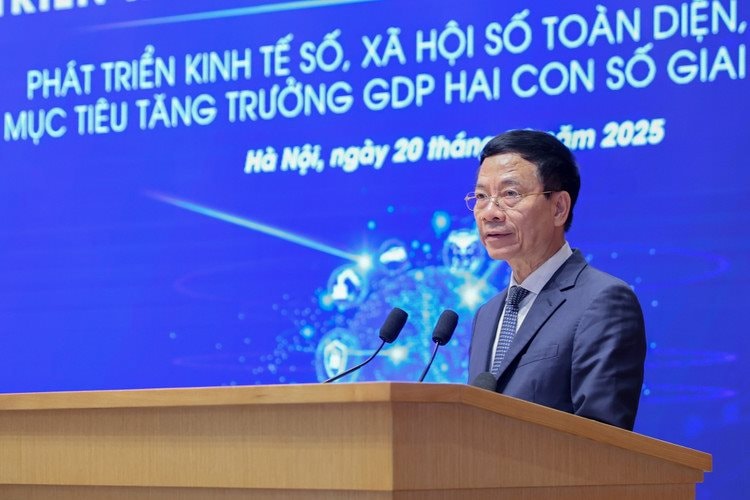
Speaking at the 3rd National Forum on digital economy and digital society development, Minister of Science and Technology Nguyen Manh Hung emphasized that in the current context, the digital economy and digital society are no longer a choice but an inevitable path, the core driver of growth and the renewal of the development model.
The Vietnam Journal of Science and Technology respectfully introduces the speech of Minister Nguyen Manh Hung at the Forum.
Today, we gather at the 3rd National Forum on digital economy and digital society development in a very particularly meaningful context. Vietnam is entering a phase of strategic acceleration to realize the aspiration of rapid and sustainable development, aiming to become a high-income nation in the coming decades. On this journey, the digital economy and digital society are no longer a choice but an inevitable path, the core driver of growth and the renewal of the development model.
At this 3rd Forum, we will discuss a major issue: How to make the digital economy and digital society truly become a “new development space” for Vietnam, rather than just the digitization of old models, to contribute decisively to double-digit growth.
The development of Vietnam's digital economy and digital society in the coming period will shift from digitizing the old to creating new development spaces, where data, AI, digital platforms, digital enterprises, and digital citizens collectively become the drivers of growth.
Vietnam's digital economy is currently characterized by the digitization of existing activities and has not yet strongly transitioned toward “creating new growth models”. While the proportion of the digital economy in GDP is increasing rapidly, domestic added value remains low, with heavy dependence on cross-border platforms and many small and medium-sized enterprises yet to truly participate in digital value chains. Therefore, the task for the next phase is not just to do more, but to do differently, more deeply, creating more added value and ensuring greater sustainability.
Consequently, we need breakthrough innovations.
First, creating a national digital economy structure instead of fragmented digitization of individual sectors. This involves moving from an approach where each industry has its own digital transformation scheme to redesigning the structure of the economy based on layers of shared digital infrastructure: telecommunications, the Internet, computing, digital data, AI, digital platforms, and digital services. The State must play the role of the chief architect of the national digital economy and digital society, shaping the structure for the market to operate. The profound essence of the digital economy is the restructuring of the entire economy: from production, distribution, and consumption methods to market organization, corporate governance, and the allocation of social resources.
The digital economy is based on new means of production, which is data; based on new production tools and machinery, which is digital infrastructure (Cloud-IoT-AI) and digital platforms; based on a new operating framework, which is the new rules on science, technology, innovation, digital transformation, digital data, digital technology, AI, and cybersecurity; based on digital subjects, which are digital enterprises and digital value chains. The digital economy is not just an additional sector, but the digitization and restructuring of every sector and field. It is further based on the essential conditions of digital citizens and digital trust - the foundation of a digital society and the prerequisite for the digital economy to operate sustainably. Without digital trust, there can be no digital transactions or digital economy.
Second, regarding data, AI, and computing power as the fundamental production capacities of the digital economy, rather than just support tools. Similar to electricity, water, and telecommunications, the State, businesses, and citizens should be able to utilize these in the form of services. Here, I want to emphasize the new role of next-generation telecommunications carriers in the development of the digital economy and digital society. Carriers do not just provide connectivity; they provide core digital capacities for businesses to build products and services and to operate the economy.
The value of a carrier lies not just in the number of subscribers, but in the number of services that other enterprises build on its network. Carriers must become the “backbone” of the national digital space, encompassing not only telecommunications networks but also data centers, cloud computing, edge computing, AI computing, and cybersecurity platforms.
Third, transitioning from e-government (digitizing procedures) to a State-driven operation based on data and forecasting models. The State is a complex system that exceeds human processing capabilities, but once moved to a digital environment, AI has the capability to process and forecast. Policies are designed, simulated, tested, and impact-evaluated by using data will be faster and more accurate. The State will manage based on risk and social impact, conducting wide-scale monitoring followed by focused inspections.
Fourth, developing a national digital market with enterprises at the center. This involves shifting from supporting enterprise digital transformation to creating a digital market, generating demand for Vietnamese enterprises, and fostering trust in Vietnamese digital firms. Vietnamese enterprises should grow within the domestic market and then expand globally, forming Vietnamese technology corporations with digital platform capabilities.
Fifth, building a digital society that is human-centered and based on digital trust. Digital transformation is ultimately the transformation of humans. It is necessary to universalize digital skills, digital thinking, and digital ethics for the whole of society; building a Vietnamese digital culture that is humane, safe, creative, and responsible. A digital society is not just about the popularization of technology but about digital empowerment for citizens, linked with trust, ethics, and digital culture. If the digital economy answers the question of “how wealth is created,” the digital society answers the question of “for whom development is intended”.
A digital society is not the one where everything is moved to the network environment, it is a society in which each citizen is empowered more through digital technology: the right to access information, the right to access public services, the right to lifelong learning, and the right to participate in social management. In a digital society, the digital citizen is not just a beneficiary but a subject participating in policy creation; the government is not just a management agency but a provider of data-driven public services; and the digital community becomes a new social space, parallel to and integrated with the physical space.
The digital economy and digital society are not just stories of technology, but stories of restructuring development, rebuilding trust, and repositioning the roles of the State, enterprises, and citizens in the digital era. With data as the foundation, platforms as the driver, institutions as the guide, and people at the center, we have the sufficient conditions to successfully transform the growth model, enhancing the productivity and quality of life for society.
The Ministry of Science and Technology is committed to continuing its role as the architect of science, technology, innovation, digital transformation, digital government, digital economy, and digital society, accompanying ministries, sectors, localities, and the business community to realize the aspiration for rapid, sustainable, and inclusive development in the digital era./.
Copyright belongs to the Vietnam Journal of Science and Technology (VJST-MOST).