

Digital government applications become more effective when accompanied by legal AI tools
Administrative reform and digital transformation are profoundly changing the way citizens are served within the government system. Specifically, the deployment of the “Legal AI” tool helps citizens access legal information more transparently, accurately, and quickly, while supporting officials in reducing pressure when handling procedures.
Completing the legal framework and digital data platform for e-government
In the process of building a digital government, the legal framework and data infrastructure are 2 key factors ensuring public services operate stably, transparently, and are auditable. The Ministry of Justice has reviewed nearly 90 overlapping regulations in decentralization and delegation to propose solutions to the Government, ensuring unified implementation across localities. This contributes to minimizing conflicts of jurisdiction, helping the two-level administrative system operate more smoothly and synchronously on the digital platform.
According to the National Digital Transformation Plan, by the end of 2026, all national databases, specialized data, and shared data will be interconnected, ending the situation of data “fragmentation.”
Decree 278/2025/ND-CP dated 20 October, 2025, of the Government, regulating mandatory data connection and sharing among agencies within the political system, requires ministries, sectors, and localities to complete data connection before this deadline, ensuring all administrative processes are handled through a unified data axis, helping citizens avoid having to re-provide information that has already been verified.
Concurrently, Decree 280/2025/ND-CP dated 27 October, 2025, of the Government on amending and supplementing a number of articles of Decree No. 23/2015/ND-CP on issuing copies from original registers, authenticating copies from original documents, authenticating signatures, and authenticating contracts and transactions, which was amended and supplemented by Decree No. 07/2025/ND-CP, allows the use of integrated data on VNeID in place of paper copies, significantly shortening the time and cost of performing administrative procedures.
The standardization of the legal framework and data synchronization is creating a solid premise for the digital government model—where public services are automated, transparent, traceable, and effectively monitored.
As of May 2025, the national rate of fully online administrative procedure records being processed reached nearly 40%, of which the ministerial/sector block achieved over 52%, while the provincial block reached approximately 15%. The target is to raise this rate to 80% by the end of 2025.
Vietnam has also climbed 8 ranks in the global digital transformation ranking, standing at 17th out of 194 countries, demonstrating significant progress in modernizing public administration.
The grassroots government level is where the effectiveness of administrative reform is most clearly reflected. When processes are digitized, citizens become the center of the service system. Dinh Cong Ward (Hanoi) is a typical example of this model. Clear decentralization of authority has helped the locality quickly resolve backlog cases, such as completely clearing a 5,000 m² encroached land area, returning public space to the residential community.
At the single-door unit, procedures are performed entirely on the electronic platform. Citizens can submit dossiers, track processing progress, and receive results online, instead of having to visit in person multiple times as before. The average processing time has been reduced from 5-7 days to 2-3 days, depending on the type of dossier, while limiting errors or delays.
Statistics show that the deployment of the two-level digital government model in many localities has helped reduce file look-up time by about 60% and reduced the rate of rejected dossiers by up to 70%. The centralized management system also allows citizens to monitor the resolution progress and assess satisfaction immediately after completing the procedure, contributing to increased transparency and enhanced accountability of public agencies.
Legal AI – a supportive tool in the digital government ecosystem
One of the notable highlights of the Justice sector in 2025 is the deployment of the “Legal AI” tool - a virtual assistant that helps citizens look up, understand, and apply legal regulations more easily.
The application is developed based on an official legal database, automatically updated upon changes, and is capable of accepting natural language queries without requiring users to be familiar with specialized terminology.
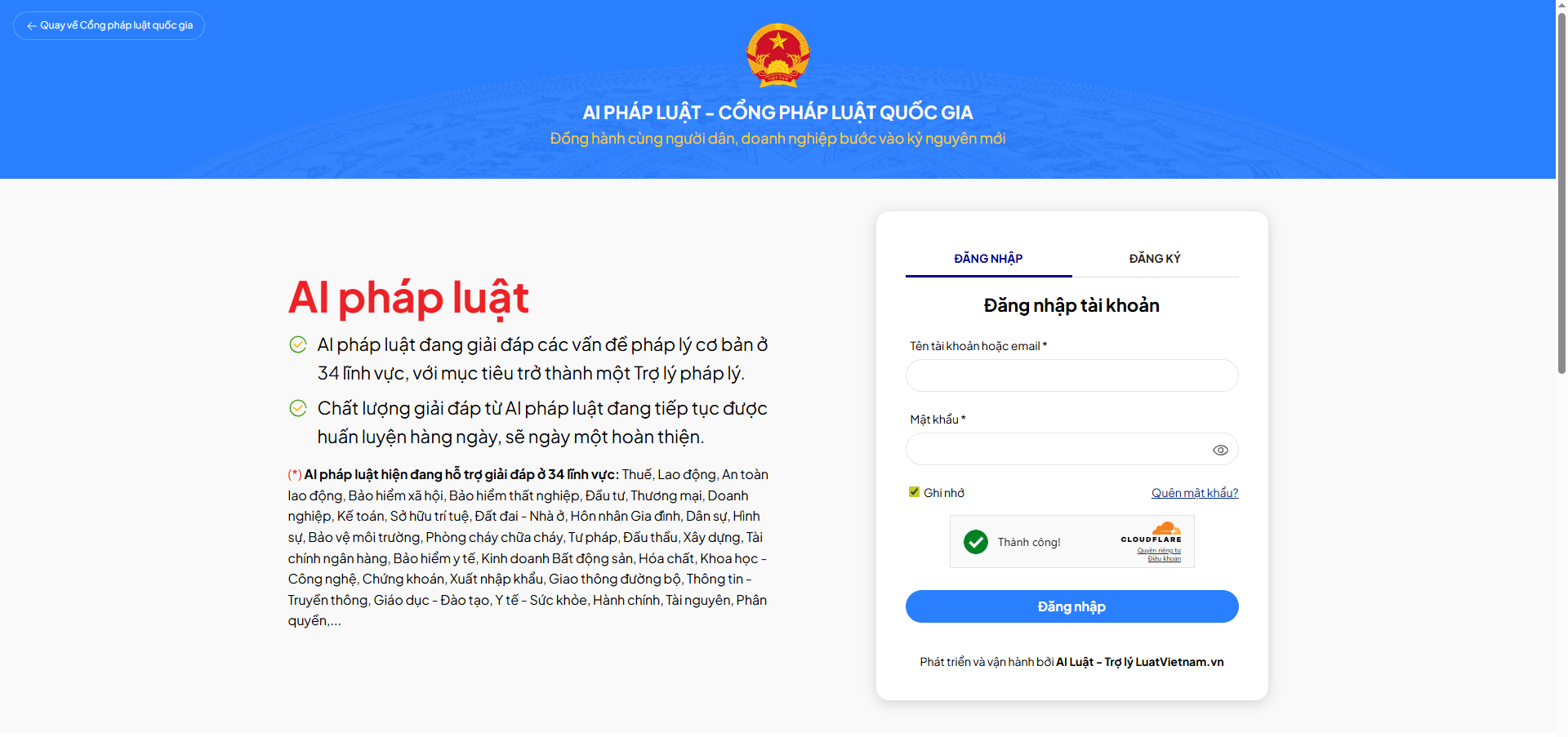
After more than 5 months of trial operation, the system has received and processed over 140,000 queries, with over 83% of users reporting satisfaction. Legal AI not only provides accurate look-up results but also summarizes texts, suggests core content, and provides cross-references to related articles, significantly saving citizens' time in understanding regulations.
For single-door officials, this tool supports quick look-up, reduces errors in guidance, and increases consistency in the application of law.
The application of AI in the Justice sector is also part of the overall national digital transformation strategy. Similar models are being piloted at the Ministry of Finance, the Ministry of Construction, and the Ministry of Agriculture and Environment to serve data analysis, policy forecasting, and automated response support.
Initial results show that when integrated synchronously, AI can significantly reduce the volume of manual work, while enhancing the accuracy, consistency, and transparency of the administrative system.
Despite achieving many positive results, the deployment of AI in the legal field still faces numerous difficulties. Vietnamese legal data is currently fragmented, voluminous but not yet standardized, causing obstacles for training and operating AI models. Many real-life situations require critical thinking, judgment, and experience - factors that technology cannot yet fully replace humans.
Furthermore, the issue of personal information security and data safety is always a top concern as electronic systems become increasingly widespread. In some localities, personnel with digital skills are limited, leading to difficulties in operating and effectively exploiting AI tools.
To overcome this, the Ministry of Justice and the Ministry of Home Affairs have coordinated to implement a digital transformation training program for civil servants, and together with the Ministry of Science and Technology, are developing an open data platform to serve the training of specialized AI models in the administrative-legal field. This is considered an important step to ensure AI is applied responsibly, effectively, and is compatible with the characteristics of the Vietnamese language and legal texts.
The combination of administrative reform, clear decentralization, and the application of artificial intelligence is opening up a new direction for the development of Vietnam's digital government. Initial results such as the high increase in the rate of online dossiers, improved citizen satisfaction, and the initial proven effectiveness of the Legal AI tool demonstrate the feasibility of this model./.
Translated by Vietnam Journal of Science and Technology (VJST - MOST).